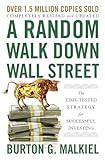
Editors Reads Verdict
Malkiel's timeless case for passive investing has been updated twelve times and remains the most authoritative book-length argument for why most investors should own index funds rather than try to beat the market.
What We Loved
- Thorough demolition of technical analysis and most market-timing strategies
- Updated editions cover new developments including behavioural finance and factor investing
- The life-cycle investing advice is practical and appropriately age-sensitive
- Backed by decades of academic and market evidence
Minor Drawbacks
- More than 400 pages for what can be summarised briefly
- Some chapters are dense with historical market data
- The core message hasn't changed across thirteen editions — only the framing
Key Takeaways
- → Stock prices reflect all available information — beating the market consistently requires information others don't have
- → Most actively managed funds underperform their benchmark index after fees over long periods
- → Low-cost index funds are the rational choice for most investors
- → Asset allocation across stocks, bonds, and real estate drives returns more than individual stock selection
- → Risk and return are inseparably linked — there are no free lunches
| Author | Burton G. Malkiel |
|---|---|
| Publisher | W. W. Norton & Company |
| Pages | 496 |
| Published | January 1, 1973 |
| Language | English |
| Genre | Investing, Personal Finance, Economics |
| Difficulty | Intermediate |
| Best For | Individual investors, particularly those considering whether to use index funds or active management for their portfolios. |
How A Random Walk Down Wall Street Compares
A Random Walk Down Wall Street at a glance against 3 similar books readers weigh alongside it.
| Book | Author | Rating | Best for |
|---|---|---|---|
| A Random Walk Down Wall Street (this book) | Burton G. Malkiel | ★ 4.5 | Individual investors, particularly those considering whether to use index funds |
| Common Stocks and Uncommon Profits | Philip A. Fisher | ★ 4.5 | Serious individual investors and students of fundamental analysis who want to |
| The Intelligent Investor | Benjamin Graham | ★ 4.7 | Anyone who wants to invest in equities with a long-term, principled framework |
| The Little Book of Common Sense Investing | John C. Bogle | ★ 4.6 | Individual investors of any experience level who want the clearest possible |
The Book Behind the Index Fund Revolution
Burton Malkiel, a Princeton economist, published the first edition of A Random Walk Down Wall Street in 1973. It argued — controversially at the time — that stock prices follow a random walk, meaning that past prices provide no reliable information about future prices, and that a blindfolded monkey throwing darts at the stock pages could select a portfolio that would do as well as one carefully assembled by professional fund managers.
Fifty years and twelve revisions later, the evidence has largely vindicated Malkiel. The majority of actively managed funds underperform their benchmark indices over long periods after fees, and the index fund he helped popularise now manages trillions of dollars on behalf of millions of ordinary investors.
The Case Against Active Management
Malkiel’s argument has two parts. First, the efficient market hypothesis: stock prices at any moment reflect all publicly available information. If everyone with access to the same information tries to profit from it simultaneously, prices adjust almost instantly, leaving no reliable profit opportunity. Second, even if some managers can outperform, fees consume the excess returns before they reach investors.
The data supporting this conclusion has only grown stronger since 1973. Long-term studies consistently show that roughly 90% of actively managed funds underperform their index benchmarks over 15-20 year periods.
Technical Analysis and Fundamental Analysis
The book systematically examines both major approaches to stock selection. Technical analysis — using charts and price patterns to predict future movements — is dismissed as finding patterns in random data. Fundamental analysis — valuing companies by their earnings, assets, and growth — is more defensible but produces above-average returns only for those with genuine informational or analytical advantages that most individual investors lack.
The Practical Programme
The book’s most valuable practical section describes a life-cycle investing approach: taking more risk (more stocks) when young and long-horizon, and shifting gradually toward safety (more bonds) as retirement approaches. Malkiel recommends low-cost, diversified index funds as the implementation vehicle at every stage.
The Random Walk and Market Efficiency
The book’s foundational and most contested idea is captured in its title: that stock prices follow a “random walk,” meaning that short-term price movements are essentially unpredictable, and that past prices contain no reliable information about future ones. This flows from the efficient market hypothesis, which holds that at any given moment a stock’s price already incorporates all publicly available information, because thousands of profit-seeking investors are constantly analyzing that information and trading on it, driving prices to adjust almost instantly. If this is true, then the elaborate apparatus of stock prediction — the chartists, the forecasters, the highly paid analysts — is largely theater, and Malkiel famously dramatized the point by claiming that a blindfolded monkey throwing darts at the stock listings could select a portfolio that performs as well as one chosen by experts. The hypothesis has always had critics, and Malkiel himself, across the book’s many editions, has softened it to acknowledge that markets are not perfectly efficient and that some anomalies and behavioral patterns exist. But the core practical implication — that consistently beating the market through stock-picking or timing is, for nearly everyone, a fool’s errand — has been overwhelmingly vindicated by the evidence.
The Triumph of the Index Fund
The most consequential legacy of A Random Walk Down Wall Street is its early, forceful advocacy for what was then a radical idea and is now mainstream wisdom: that most investors should simply buy low-cost index funds and hold them. If markets are largely efficient and active managers cannot reliably outperform, then paying high fees for active management is worse than pointless — it is a near-guaranteed way to underperform the market after costs. Malkiel made this case in 1973, before index funds were widely available to ordinary investors, and the subsequent half-century has proven him right with remarkable force: study after study confirms that the large majority of actively managed funds fail to beat their benchmark indices over long horizons, with the gap explained almost entirely by fees. The index fund that Malkiel championed now manages trillions of dollars and has saved ordinary investors untold sums in avoided fees and improved returns. Few investment books can claim to have shaped the actual behavior of millions of people and the structure of the financial industry so directly, and this practical influence is the book’s enduring monument.
Practical Wisdom for Every Investor
For all its theoretical apparatus, A Random Walk Down Wall Street is at heart a practical guide, and its concrete advice has aged remarkably well across twelve editions and five decades. Malkiel offers a sensible, evidence-based program built on a few durable principles: diversify broadly through low-cost index funds; minimize fees and taxes, which compound against the investor as relentlessly as returns compound for them; rebalance periodically; and follow a “life-cycle” approach that holds more stocks when young and shifts gradually toward bonds as retirement nears. He systematically dismantles the two dominant schools of stock selection — technical analysis, which he likens to finding meaning in random noise, and fundamental analysis, which he concedes is more defensible but argues yields an edge only to those few with genuine informational advantages most individuals lack. The advice is unglamorous, which is precisely its virtue: Malkiel’s enduring message is that successful investing is not about cleverness or prediction but about discipline, low costs, diversification, and patience.
Final Verdict
The theoretical argument can be contested at the margins, but the practical conclusion is robust: most investors, most of the time, will achieve better results from low-cost index funds than from actively managed alternatives. This book makes the case with fifty years of supporting evidence.
Our rating: 4.5/5 — The definitive case for passive investing. Read this before you pay anyone to manage your money.
Reading Guides
Frequently Asked Questions
What is "A Random Walk Down Wall Street" about?
The classic argument for efficient markets and passive investing — now in its thirteenth edition — explaining why index funds outperform most actively managed portfolios.
Who should read "A Random Walk Down Wall Street"?
Individual investors, particularly those considering whether to use index funds or active management for their portfolios.
What are the key takeaways from "A Random Walk Down Wall Street"?
Stock prices reflect all available information — beating the market consistently requires information others don't have Most actively managed funds underperform their benchmark index after fees over long periods Low-cost index funds are the rational choice for most investors Asset allocation across stocks, bonds, and real estate drives returns more than individual stock selection Risk and return are inseparably linked — there are no free lunches
Is "A Random Walk Down Wall Street" worth reading?
Malkiel's timeless case for passive investing has been updated twelve times and remains the most authoritative book-length argument for why most investors should own index funds rather than try to beat the market.
Ready to Read A Random Walk Down Wall Street?
Check the current price on Amazon.
Check Price on Amazon (paid link)Prices and availability are subject to change. See Amazon for current price.
Review last updated: