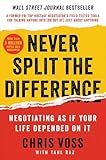
Editors Reads Verdict
The best negotiation book published in the last decade. Where most negotiation advice is built on the assumption of rational actors (Getting to Yes, Harvard Negotiation Project), Voss builds from the reality of emotional, irrational humans. His techniques — tactical empathy, calibrated questions, the power of 'no' — are immediately transferable and psychologically grounded.
What We Loved
- The best negotiation book of the past decade — outperforms the Harvard Negotiation Project for real-world use
- Based on actual high-stakes situations (hostage negotiations, terrorism) — the techniques are tested under real pressure
- Tactical empathy and mirroring are immediately learnable and applicable
- Counter-intuitive — genuinely overturns things you thought you knew about negotiation
- The 'calibrated questions' framework is the most useful single tool in the book
Minor Drawbacks
- The hostage negotiation framing occasionally overstates the stakes of normal business situations
- Some techniques (like the late-night DJ voice) require practice to not come across as strange
- Less useful for large-scale complex negotiations than for interpersonal ones
Key Takeaways
- → Tactical empathy: demonstrate you understand your counterpart's feelings — not agreeing, just understanding
- → Mirroring: repeat the last 1-3 words your counterpart said — they will elaborate and reveal information
- → 'No' is not rejection — it's often the beginning of real negotiation and a sign of engagement
- → Calibrated questions begin with 'How' or 'What' — they give the other side the illusion of control while extracting information
- → The Accusation Audit: list every negative thing your counterpart might think about you, out loud, first
| Author | Chris Voss |
|---|---|
| Publisher | Harper Business |
| Pages | 288 |
| Published | May 17, 2016 |
| Language | English |
| Genre | Business, Psychology, Self-Help |
| Difficulty | Beginner |
| Best For | Anyone who negotiates — which is everyone. Particularly valuable for salary negotiations, business deals, conflict resolution at work, and high-stakes personal conversations. Required reading for anyone in sales or management. |
How Never Split the Difference Compares
Never Split the Difference at a glance against 3 similar books readers weigh alongside it.
| Book | Author | Rating | Best for |
|---|---|---|---|
| Never Split the Difference (this book) | Chris Voss | ★ 4.7 | Anyone who negotiates — which is everyone |
| How to Win Friends and Influence People | Dale Carnegie | ★ 4.7 | Anyone who wants to build better professional relationships, be more |
| Influence | Robert Cialdini | ★ 4.7 | Anyone who negotiates, sells, manages people, or simply wants to understand why |
| Thinking, Fast and Slow | Daniel Kahneman | ★ 4.6 | Investors, doctors, lawyers, managers, policymakers, and any curious person who |
Negotiation as Emotional Intelligence
For decades, the dominant approach to negotiation was built on a rational-actor model: assume your counterpart has clear interests, find the zone of possible agreement, make logical exchanges. The Harvard Negotiation Project’s Getting to Yes (1981) systematised this approach and influenced a generation of negotiators and business schools.
Chris Voss spent 24 years as an FBI hostage negotiator, including as the Bureau’s lead international kidnapping negotiator. The people he negotiated with — terrorists, kidnappers, armed bank robbers — were not rational actors making calculated decisions. They were frightened, angry, irrational humans responding to emotional pressures.
The techniques Voss developed to deal with them are more effective, he argues, precisely because they work on humans as they actually are, not as economists model them to be.
The Core Insight: Emotions First
Standard negotiation advice treats emotions as obstacles to overcome — the noise you clear away to reach the underlying interests. Voss treats emotions as the primary mechanism of influence.
His framework is built on tactical empathy — the deliberate attempt to understand your counterpart’s emotional state and make them feel understood, not to agree with them or feel sorry for them, but simply to demonstrate comprehension. When people feel understood, they become more open. When they feel challenged or dismissed, they become defensive.
Tactical empathy is different from regular empathy because it’s strategic: you deploy it deliberately to move the negotiation forward.
The Techniques
Mirroring. Repeat the last one to three words your counterpart said, in a slightly questioning tone. They will elaborate. People instinctively fill silence and expand on what they’ve just said when their words are reflected back to them. Mirroring extracts information without requiring you to ask questions that could seem aggressive.
Labelling. Name the emotion you observe: “It seems like this is really frustrating for you.” or “It sounds like you’re concerned about the timeline.” Labelling makes people feel heard and often defuses negative emotions. Counter-intuitively, labelling negative emotions (frustration, anger, fear) reduces their intensity.
The Accusation Audit. Before asking for something, list every negative thing your counterpart might be thinking about you or your request, out loud, proactively. “You’re probably thinking this is going to cost more than you budgeted. You might be wondering if this is even going to work.” This disarms resistance by demonstrating self-awareness.
Calibrated Questions. Questions beginning with “How” or “What” that give your counterpart the sense of control while forcing them to solve your problem. “How am I supposed to do that?” is more powerful than “no.” “What would need to happen for this to work?” invites your counterpart to generate solutions.
The Power of “No”. Most people treat “no” as failure. Voss argues it’s the most useful word in negotiation: it gives people a sense of control and protection, and it starts the real conversation. Getting to “no” quickly often clears the way for eventual “yes”.
For Everyday Use
The hostage negotiation context makes the techniques memorable, but the applications are entirely ordinary: salary negotiations, vendor discussions, conflict resolution with colleagues, difficult conversations with partners or children. The emotional dynamics are the same whether the stakes are life-or-death or whether you’re negotiating a raise.
Voss teaches a three-semester negotiation course at Georgetown’s business school. The reading list includes Never Split the Difference and Cialdini’s Influence — and this review would recommend reading both, in that order.
Our rating: 4.7/5 — The most practically useful negotiation book of the past decade. Learn the calibrated question framework alone and you will negotiate better for the rest of your life.
Negotiation From the Hostage Line
The hook of Never Split the Difference is its author’s background: Chris Voss was the FBI’s lead international hostage negotiator, and he builds his approach to everyday negotiation on techniques refined in situations where a wrong move could cost lives. That origin gives the book its distinctive flavour and its central claim — that the rational, compromise-seeking models taught in business schools miss how negotiation actually works, because people are driven by emotion rather than logic. Voss’s argument is that you win not by splitting the difference but by understanding and shaping the other side’s emotional reality.
Tools You Can Actually Use
What makes the book genuinely useful is the concreteness of its techniques. Tactical empathy, labelling the other side’s emotions, the “accusation audit” that defuses objections by naming them first, the deliberately calm late-night-radio voice, and the counterintuitive power of getting someone to say “that’s right” rather than “yes” — these are specific, teachable moves rather than vague principles. Readers come away with an actual toolkit, which is rarer in the genre than it should be.
Beyond the Boardroom
Although framed around negotiation, much of the book is really about communication and influence in any high-stakes conversation, from salary discussions to family conflicts. Voss’s emphasis on listening, on making the other person feel understood, and on managing emotion rather than ignoring it generalises well beyond formal deals. That breadth is part of why the book found a far larger audience than negotiation manuals usually reach.
How to Read It
The dramatic hostage anecdotes are entertaining and memorable, though the reader should keep some perspective: techniques honed in extreme, one-off, high-pressure situations do not always map cleanly onto ongoing relationships where you have to keep dealing with the same person. Used thoughtfully rather than as manipulation, though, Voss’s methods are a real upgrade on the win-win platitudes most people absorb, and Never Split the Difference has become one of the most practical and widely recommended books on the subject for exactly that reason.
Reading Guides
Frequently Asked Questions
What is "Never Split the Difference" about?
Former FBI lead hostage negotiator Chris Voss reveals the counter-intuitive techniques he developed for life-or-death negotiations — and shows how they apply to salary talks, business deals, and everyday persuasion. The key insight: humans are not rational actors, and the best negotiators use emotional intelligence, not logic.
Who should read "Never Split the Difference"?
Anyone who negotiates — which is everyone. Particularly valuable for salary negotiations, business deals, conflict resolution at work, and high-stakes personal conversations. Required reading for anyone in sales or management.
What are the key takeaways from "Never Split the Difference"?
Tactical empathy: demonstrate you understand your counterpart's feelings — not agreeing, just understanding Mirroring: repeat the last 1-3 words your counterpart said — they will elaborate and reveal information 'No' is not rejection — it's often the beginning of real negotiation and a sign of engagement Calibrated questions begin with 'How' or 'What' — they give the other side the illusion of control while extracting information The Accusation Audit: list every negative thing your counterpart might think about you, out loud, first
Is "Never Split the Difference" worth reading?
The best negotiation book published in the last decade. Where most negotiation advice is built on the assumption of rational actors (Getting to Yes, Harvard Negotiation Project), Voss builds from the reality of emotional, irrational humans. His techniques — tactical empathy, calibrated questions, the power of 'no' — are immediately transferable and psychologically grounded.
Ready to Read Never Split the Difference?
Check the current price on Amazon.
Check Price on Amazon (paid link)Prices and availability are subject to change. See Amazon for current price.
Review last updated: