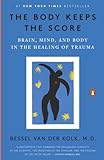
Editors Reads Verdict
The most important book on trauma written for a general audience. Van der Kolk's synthesis of neuroscience, psychology, and decades of clinical practice is both scientifically rigorous and deeply humanising. Required reading for therapists, trauma survivors, and anyone who wants to understand why they feel the way they feel.
What We Loved
- Written by one of the world's leading trauma researchers — unimpeachable authority
- Covers a wide spectrum of trauma treatment approaches (EMDR, yoga, theatre, neurofeedback)
- Deeply compassionate without being sentimental
- Explains why conventional talk therapy often fails trauma survivors
Minor Drawbacks
- Dense and detailed — requires patience in places
- Some treatments covered are not yet widely available or clinically established
- Emotionally challenging — some sections may be difficult for trauma survivors
Key Takeaways
- → Trauma is not stored as a narrative memory but as physical, bodily sensations
- → The brain's alarm system (amygdala) remains on high alert long after danger has passed
- → Talk therapy alone is often insufficient for trauma — the body must be addressed
- → Social connection is the most powerful trauma antidote — isolation makes things worse
- → PTSD is not a disorder of weak people — it is the brain's adaptive response to overwhelming experience
| Author | Bessel van der Kolk |
|---|---|
| Publisher | Penguin Books |
| Pages | 464 |
| Published | September 8, 2015 |
| Language | English |
| Genre | Psychology, Health, Neuroscience |
| Difficulty | Intermediate |
| Best For | Therapists, counsellors, trauma survivors and those who love them, anyone working in mental health or social care, and curious readers interested in how adversity shapes the brain. |
How The Body Keeps the Score Compares
The Body Keeps the Score at a glance against 3 similar books readers weigh alongside it.
| Book | Author | Rating | Best for |
|---|---|---|---|
| The Body Keeps the Score (this book) | Bessel van der Kolk | ★ 4.7 | Therapists, counsellors, trauma survivors and those who love them, anyone |
| Man's Search for Meaning | Viktor E. Frankl | ★ 4.8 | Anyone confronting meaninglessness, loss, suffering, or existential questions |
| Thinking, Fast and Slow | Daniel Kahneman | ★ 4.6 | Investors, doctors, lawyers, managers, policymakers, and any curious person who |
| Why We Sleep | Matthew Walker | ★ 4.5 | Anyone who regularly gets less than 7 hours of sleep and rationalises it — |
The Book That Reframed How We Understand Trauma
For decades, trauma was treated primarily as a cognitive problem — something to be talked through, analysed, and narrated into coherence. Bessel van der Kolk spent 40 years in clinical practice and research discovering that this approach often fails the people who need it most.
The Body Keeps the Score — which spent years on the New York Times bestseller list — is the comprehensive account of why trauma works differently than previously understood, and what actually helps.
The Core Insight: Trauma Lives in the Body
The book’s title captures its central revelation: trauma is not stored primarily as explicit memory but as physical experience.
When someone is in danger, the brain’s alarm system (the amygdala) floods the body with stress hormones — cortisol, adrenaline — triggering the fight-or-flight response. This is adaptive and life-saving.
The problem comes when the threat passes but the alarm system doesn’t turn off. In trauma survivors, sensory triggers — a smell, a sound, a posture — can re-activate the full physiological trauma response decades later. The body has not learned that it is safe. It is reliving, not remembering.
This is why trauma survivors often can’t “just get over it” or respond to rational reassurance — the response is subcortical, below the reach of conscious thought.
What This Means for Treatment
If trauma lives in the body, treatment must address the body. Van der Kolk documents why conventional talk therapy often provides incomplete relief for severe trauma, and presents a range of approaches that engage the body directly:
EMDR (Eye Movement Desensitisation and Reprocessing) — a technique using bilateral stimulation to help the brain process traumatic memories without re-traumatisation. One of the most thoroughly evidence-based trauma treatments.
Yoga — Van der Kolk’s research at Boston Medical Centre documented significant PTSD symptom reduction in survivors who practised yoga. Learning to inhabit and regulate the body safely is foundational.
Neurofeedback — training the brain’s electrical patterns using real-time EEG feedback. Still emerging as a field but showing promise for treatment-resistant PTSD.
Theatre and movement — van der Kolk describes a project with inner-city youth using Shakespeare to process trauma, with striking results. Embodied, collaborative performance engages trauma circuits that talk therapy misses.
The Neuroscience of Trauma
The book is impressive in its neuroscientific depth. Van der Kolk explains how trauma affects:
- The prefrontal cortex — the “rational brain” goes offline under extreme stress; in trauma survivors, this shutdown can be triggered by relatively minor events
- The amygdala — becomes hypersensitive, detecting threats in benign situations
- Broca’s area — the speech centre literally shuts down during trauma flashbacks, explaining why survivors often can’t speak about what happened
- The default mode network — disturbed in trauma survivors, disrupting self-continuity and the sense of being “at home” in one’s own life
Why This Book Reached Millions
The Body Keeps the Score has resonated beyond clinical circles because it validates what trauma survivors already knew but couldn’t articulate: their reactions aren’t weakness or irrationality — they are the predictable consequence of overwhelm. The book offers not just explanation but hope, through its documentation of what genuinely helps.
Our rating: 4.7/5 — A watershed work in psychological literature. Deeply compassionate, rigorously scientific, and practically important for anyone touched by trauma.
Why the Book Struck a Nerve
Van der Kolk’s central claim is in the title: trauma is not only a psychological memory but a physical imprint, something that lives in the nervous system, the muscles, and the body’s alarm responses long after the mind has tried to move on. This reframing — that the symptoms of trauma are the body’s adaptations rather than character flaws — has been profoundly validating for millions of readers, which is much of why the book became a long-running bestseller years after publication. Drawing on decades of clinical work, he argues that talk therapy alone is often insufficient, and makes the case for approaches that engage the body directly, from movement and breath to newer techniques, in the work of recovery.
How to Read It Responsibly
The book’s popularity has also drawn scrutiny, and the careful reader should hold its enthusiasm in balance. Some of the specific therapies van der Kolk champions have a stronger evidence base than others, and the sweeping, accessible style that makes the book so readable can blur the line between established science and promising hypothesis. It is best approached as a compassionate, illuminating overview that has helped many people understand their own experience — not as a clinical manual or a substitute for professional care. Readers dealing with trauma should treat it as a starting point for conversation with a qualified therapist rather than a self-directed treatment plan. Read with that caution, it remains a genuinely important book for understanding how deeply experience can mark the body, and why recovery so often has to involve more than words.
Why It Endured on the Bestseller Lists
It is unusual for a book about trauma by a clinician to spend years near the top of the bestseller lists, and the phenomenon says something about both the book and its moment. Van der Kolk gave an enormous number of readers a framework that made their own experience legible — the sense that the body’s persistent alarm was an adaptation rather than a personal failing — at a time of rising public attention to trauma and mental health. That validating quality is the book’s great strength and the reason to read it with care: a framework this resonant can be applied more broadly than the evidence supports. Taken as a humane, illuminating introduction rather than a treatment manual, and paired with professional guidance, it remains one of the most influential popular books on trauma of recent years.
Reading Guides
- 15 Books Like The Body Keeps the Score to Read Next
- 15 Books Like Becoming to Read Next
- 15 Books Like Born a Crime to Read Next
- 15 Books Like Can
- 15 Books Like Daring Greatly to Read Next
- 12 Best Psychology Books of All Time (Expert Ranked)
- Best Books About Mental Health: 12 Essential Reads for Understanding the Mind
Frequently Asked Questions
What is "The Body Keeps the Score" about?
A landmark work in trauma psychology by one of the world's foremost authorities on PTSD. Van der Kolk reveals how trauma reshapes both body and brain, undermining survivors' capacity for pleasure, engagement, self-control, and trust.
Who should read "The Body Keeps the Score"?
Therapists, counsellors, trauma survivors and those who love them, anyone working in mental health or social care, and curious readers interested in how adversity shapes the brain.
What are the key takeaways from "The Body Keeps the Score"?
Trauma is not stored as a narrative memory but as physical, bodily sensations The brain's alarm system (amygdala) remains on high alert long after danger has passed Talk therapy alone is often insufficient for trauma — the body must be addressed Social connection is the most powerful trauma antidote — isolation makes things worse PTSD is not a disorder of weak people — it is the brain's adaptive response to overwhelming experience
Is "The Body Keeps the Score" worth reading?
The most important book on trauma written for a general audience. Van der Kolk's synthesis of neuroscience, psychology, and decades of clinical practice is both scientifically rigorous and deeply humanising. Required reading for therapists, trauma survivors, and anyone who wants to understand why they feel the way they feel.
Ready to Read The Body Keeps the Score?
Check the current price on Amazon.
Check Price on Amazon (paid link)Prices and availability are subject to change. See Amazon for current price.
Review last updated: