Alec Leamas, a British spy run ragged in Berlin, is brought back to London and offered one last mission: pose as a defector to bring down an East German intelligence chief. The mission is not what it appears to be. Le Carré's third novel made him famous and established the moral framework of serious spy fiction.
A linked collection of stories about a platoon of American soldiers in Vietnam, narrated by a character named Tim O'Brien, that blurs the line between fact and fiction to argue that emotional truth matters more than factual accuracy.
Over a million Soviet women served in World War II—as snipers, pilots, surgeons, tank drivers. Alexievich interviewed hundreds of them in the late 1970s and 1980s, recording what official history excluded: not the heroic war but the sensory war—the smell, the weight, the dreams, the return home, the silence that followed.
Two agents on opposite sides of a time war — Red from a technological future, Blue from an organic one — begin leaving letters for each other in the timelines they traverse. What begins as provocation becomes correspondence, and correspondence becomes something neither of them can afford and neither can stop.
A neuroscientist reveals the life-transforming power of sleep. Walker shows why sleep is the single most effective thing you can do to reset your brain and body — and the catastrophic consequences of neglecting it.
Bill Bryson returns to America after twenty years in England and decides to hike the Appalachian Trail — 2,200 miles from Georgia to Maine — with his out-of-shape friend Stephen Katz. They complete a memorable portion of it.
Ronan Farrow's account of his investigation into Harvey Weinstein and the machinery built to silence his accusers. Part exposé, part spy thriller, it reveals the surveillance, intimidation, and corporate complicity arrayed against the reporting that helped ignite the #MeToo movement.
Twelve short stories that open the minimalist compression of Carver's earlier work into something wider and more generous. A blind man visits a narrator who resents his presence; a woman whose husband has died asks to be taken to the ocean; a couple moves into a new house and finds their marriage reconfigured by distance. Carver at his most humane and his most hopeful.
Two rival young journalists, unknowingly connected by a pair of enchanted typewriters, fall for each other through anonymous letters even as a war between old gods pulls them toward the front lines.
A Stanford psychiatrist explains how the flood of dopamine-triggering pleasures in modern society creates compulsive behaviour — and how to reset the pleasure-pain balance.
The groundbreaking book that introduced the concept of emotional intelligence to mainstream audiences and argued that EQ matters more than IQ for life success.
The landmark collection of Singer's short fiction, anchored by 'Gimpel the Fool'—translated by Saul Bellow—in which a village baker who everyone believes is a fool turns out to be the wisest man in Frampol. The other stories range across the shtetl world of pre-war Poland: demons, desire, rabbis, heretics.
William Dodd, the first US Ambassador to Hitler's Germany, arrives in Berlin in 1933 with his family. Through his diary and his daughter Martha's letters and memoirs, Larson reconstructs what it was like to watch the Nazi regime consolidate power from inside the American Embassy.
The ninth and final Expanse novel. As the Laconian empire fractures and the unknowable enemy beyond the gates moves to erase humanity, the crew of the Rocinante make their last stand to save not a nation but the survival of consciousness itself.
Pi Patel, the son of an Indian zookeeper, survives a shipwreck in the Pacific Ocean and spends 227 days in a lifeboat with a 450-pound Bengal tiger named Richard Parker, in a story about survival, faith, and the nature of truth itself.
Schwager interviews seventeen of the most successful traders of the 1970s and 1980s — Michael Marcus, Bruce Kovner, Richard Dennis, Paul Tudor Jones, Ed Seykota, and others. Each interview reveals a different trading philosophy and approach, while a consistent set of principles emerges across all of them.
One day—from reveille to lights out—in the life of Ivan Denisovich Shukhov, a peasant soldier serving eight years in a Stalinist labor camp. Solzhenitsyn's 1962 novella was the first published account of the Gulag to appear in the Soviet Union, approved by Khrushchev as a tool against Stalin's legacy.
Al-Sayyid Ahmad Abd al-Jawad rules his Cairo household with absolute authority while leading a secret life of pleasure and debauchery outside it — the first volume of Mahfouz's Cairo Trilogy follows his family through World War I and the Egyptian nationalist movement of 1919.
The fourth and final Rabbit novel, winner of the Pulitzer Prize. In the late 1980s, Harry Angstrom — overweight, ailing, semi-retired in Florida — confronts mortality, a faltering family business, and the long account of a life lived mostly on instinct.
Written as fiction but widely understood as the autobiography of Jesse Livermore — the greatest stock speculator of the early twentieth century — this 1923 classic follows the narrator's career from bucket shops to Wall Street, through multiple fortunes made and lost, and distils lessons about markets, timing, and human nature that remain current.
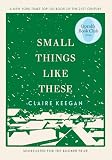
In a small Irish town in the weeks before Christmas 1985, a coal merchant named Bill Furlong begins to see what the respected convent at the edge of town is hiding — and must decide whether to look away or act.
What happens to human bodies donated to science — surgical training, crash testing, forensic decomposition research, ballistics testing, and the specific history of what cadavers have contributed to human knowledge. Rendered with Roach's characteristic meticulous research and deadpan wit.
Rose grows up poor in a small Ontario town, in the back half of a house where her stepmother Flo runs a store. Through ten linked stories, she escapes via scholarship to university, marries above her class, divorces, becomes an actress, and discovers that escape from where you came from is never as complete as you planned.
Disclosure: Editors Reads is a participant in the Amazon Services LLC Associates Program. When you click an Amazon link and make a purchase, we may earn a commission at no additional cost to you. This helps fund our independent editorial team.
We use cookies to understand how visitors use our site (Google Analytics). No data is collected until you accept.
Privacy Policy