Science fiction is the literature of consequences: every great novel in the genre asks "what if?" and follows the answer wherever it leads. These are the science fiction novels worth reading.
Ryland Grace wakes up alone on a spacecraft millions of miles from Earth, with no memory of how he got there. As he pieces together the mission, he realises he may be humanity's last hope against a microscopic threat that is slowly extinguishing the Sun — and that he is not entirely alone.
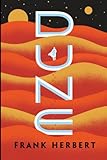
On the desert planet Arrakis, young Paul Atreides must navigate political intrigue, ecological disaster, and prophetic destiny to avenge his family and fulfil a legend centuries in the making. The best-selling science fiction novel of all time.
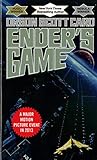
Andrew 'Ender' Wiggin is humanity's most gifted military mind, trained from childhood in the zero-gravity Battle Room of a space station to fight the alien Formics. But the game and the war may not be as separate as Ender believes.
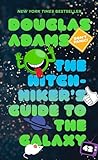
Seconds before Earth is demolished to make way for a hyperspace bypass, Arthur Dent is rescued by Ford Prefect — who turns out to be a researcher for the Hitchhiker's Guide to the Galaxy, the standard repository for all knowledge and wisdom in the universe. Their adventures take them to the Restaurant at the End of the Universe, a planet populated by telephone sanitisers, and a search for the Ultimate Question to Life, the Universe, and Everything.
Astronaut Mark Watney is stranded alone on Mars after his crew evacuates, and must use science, engineering, and dark humour to survive until a rescue mission can reach him.
A billionaire's dinosaur theme park — built using ancient DNA extracted from prehistoric mosquitoes — collapses into chaos when the animals escape containment, in a gripping techno-thriller that is also a serious argument about the limits of human control over nature.
Charlie Gordon, a man with intellectual disabilities, undergoes experimental brain surgery that dramatically increases his intelligence — and must grapple with the emotional and social consequences.
The first book in Asimov's groundbreaking Foundation series, in which mathematician Hari Seldon predicts the fall of a galactic empire and sets in motion a thousand-year plan to preserve civilisation.
In the World State of 632 AF (After Ford), human beings are hatched in hatcheries, conditioned from birth for their social function, and kept content by the pleasure drug Soma. There is no disease, no war, no poverty — and no freedom, no art, no genuine love. Bernard Marx begins to question whether happiness without meaning is worth having.
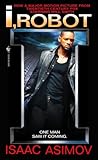
Isaac Asimov's linked short story collection introducing the Three Laws of Robotics and exploring their logical implications in a series of increasingly complex scenarios.
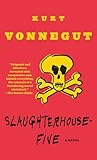
Kurt Vonnegut's anti-war masterpiece follows Billy Pilgrim, who has become 'unstuck in time' and moves non-linearly through his experiences as a prisoner of war in Dresden and his later suburban American life.
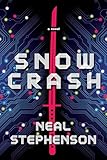
A pizza delivery driver who moonlights as a hacker navigates the Metaverse — Stephenson's invented virtual reality — to unravel a conspiracy involving a powerful new drug and ancient Sumerian linguistics.
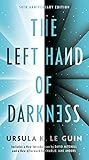
Le Guin's landmark science fiction novel about an envoy from a galactic federation who visits a planet whose inhabitants are ambisexual — neither male nor female — and the profound implications for society and consciousness.
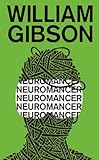
William Gibson's groundbreaking cyberpunk novel coined the term 'cyberspace' and defined the aesthetic and concerns of an entire science fiction movement.
In a future dystopia, teenager Wade Watts escapes reality in the OASIS virtual reality world and joins a global competition to find a hidden treasure that will determine control of the internet.
Six years after the Jurassic Park disaster, a separate island — Site B — is discovered still teeming with dinosaurs that have been surviving without human interference. Ian Malcolm leads a small expedition to study them, unaware that they're not the only ones there.
A series of linked stories following the colonisation of Mars by humans fleeing an increasingly troubled Earth — a work less concerned with the science of space travel than with what humanity brings with it, and what it destroys in the process.
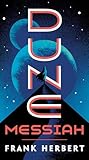
Twelve years after his jihad swept across the known universe, Paul Muad'Dib sits on the throne of an empire built on ten billion dead. His prescience is a prison, his legend a weapon turned against him, and a conspiracy is forming to finally bring him down.
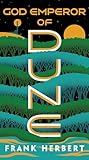
Paul Atreides is gone. His twin children, Leto II and Ghanima, inherit both his bloodline and his terrifying prescience — while a crumbling empire and Alia's increasingly erratic regency threaten to consume everything Paul built and sacrificed.